

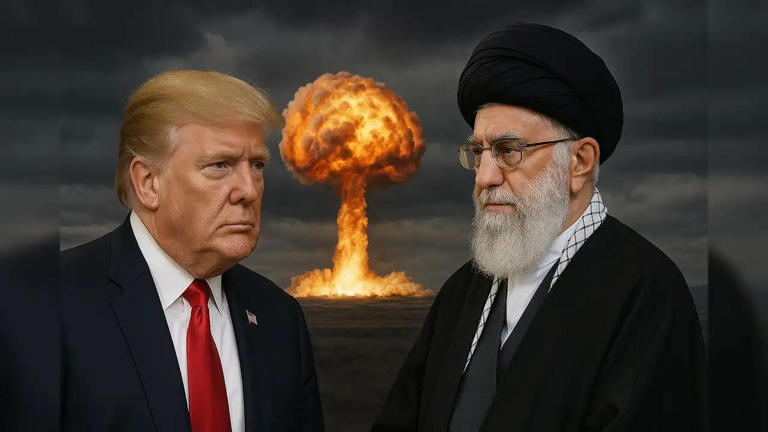
Iran has declared a 40-day national mourning period after Supreme Leader Ali Khamenei was killed in joint military strikes carried out by the United States and Israel, according to Iranian state media. The development marks one of the most significant blows to Iran’s leadership since the 1979 Islamic Revolution and represents a major escalation in the ongoing regional conflict.
What Happened?
Iranian state media confirmed that Khamenei was killed during coordinated US–Israeli strikes targeting military and nuclear-linked facilities across the country.
Reports also indicate that several top Iranian security officials were killed in the attacks, along with members of Khamenei’s immediate family, including his daughter, son-in-law and grandson.
The strikes occurred amid an expanding military confrontation that began intensifying in late February 2026 after months of fluctuating nuclear negotiations and renewed hostilities.
Iran’s Official Response
Iranian President Masoud Pezeshkian condemned the killing as “a great crime,” according to a statement from his office.
Authorities announced:
- A 40-day national mourning period
- Seven additional public holidays
- State-organised mourning ceremonies across major cities
Footage aired by state media showed large crowds gathering at Tehran’s Enghelab Square and at the shrine of Imam Reza in Mashhad. Reports also noted protests in cities including Shiraz, Yasuj and Lorestan.
However, international news agencies cited witnesses reporting isolated celebrations in parts of Tehran, Karaj and Isfahan, reflecting a divided domestic reaction.
Regional Reaction
The killing has triggered protests beyond Iran’s borders.
In Iraq, authorities declared three days of public mourning. Demonstrators gathered near Baghdad’s Green Zone, which houses government offices and foreign embassies. Some protesters reportedly attempted to mobilise toward the US Embassy.
In Pakistan, demonstrations were reported in Karachi, where protesters targeted the US consulate building.
Security alerts were raised across several Gulf states following Iranian retaliatory strikes.
Iran’s Interim Leadership Structure
According to Iran’s official IRNA news agency, a temporary three-person council will assume leadership duties until a new supreme leader is selected.
The council reportedly consists of:
- The President
- The Chief of the Judiciary
- A jurist from the Guardian Council
This arrangement is designed to oversee state affairs during the transitional period.
Who Was Ali Khamenei?
Ali Khamenei assumed leadership of Iran in 1989 following the death of Ruhollah Khomeini, who led the 1979 Islamic Revolution.
While Khomeini was regarded as the ideological architect of the revolution that ended the Pahlavi monarchy, Khamenei consolidated power over Iran’s military, intelligence and religious institutions.
During his tenure, Iran expanded:
- The authority of the Islamic Revolutionary Guard Corps (IRGC)
- Its regional influence through allied armed groups
- Its nuclear programme, which became the focal point of international tensions
Khamenei’s leadership shaped Iran’s domestic governance structure and foreign policy posture for more than three decades.
Escalation Across the Region
Following Khamenei’s death, Iran’s Islamic Revolutionary Guard Corps pledged retaliation.
Iran reportedly launched missile and drone strikes targeting:
- Israeli military facilities in Tel Aviv
- US military bases across the Gulf region
- Installations in Qatar, the United Arab Emirates, Kuwait, Bahrain, Jordan, Saudi Arabia and Iraq
Explosions were reported in parts of Qatar and the UAE, while several countries temporarily closed their airspace.
US President Donald Trump warned Iran that any further retaliation would be met with unprecedented force.
Casualties and Humanitarian Impact
Iranian state media, citing the Red Crescent, reported that at least 201 people were killed across 24 provinces during the US–Israeli strikes.
In southern Iran, a strike on an elementary school in Minab reportedly resulted in at least 148 deaths and 95 injuries, according to state sources. The casualty figures remain subject to independent verification.
What Happens Next?
The death of Iran’s supreme leader creates significant uncertainty regarding:
- The country’s internal political stability
- The succession process
- The future of Iran’s nuclear negotiations
- The risk of a broader regional conflict
Strategic analysts have cautioned that leadership “decapitation” strategies can produce unpredictable outcomes, particularly if successor factions compete for control.
Diplomatic efforts appear stalled in the immediate aftermath of the escalation.
Why This Is a Historic Turning Point
Khamenei’s death represents:
- The first killing of a sitting Iranian supreme leader
- A dramatic escalation beyond previous proxy conflicts
- A moment that could reshape Iran’s internal political structure
- A potential inflection point in US–Iran and Israel–Iran relations
The coming weeks will likely determine whether the region moves toward prolonged war, containment, or renewed diplomatic engagement.
Conclusion By Factcheck India
Iran’s declaration of 40 days of mourning following the killing of Ali Khamenei underscores the gravity of the moment. The event marks a historic shift in Iran’s leadership structure and significantly heightens tensions across the Middle East. With retaliatory strikes underway and diplomatic channels strained, the regional and global implications remain fluid.