

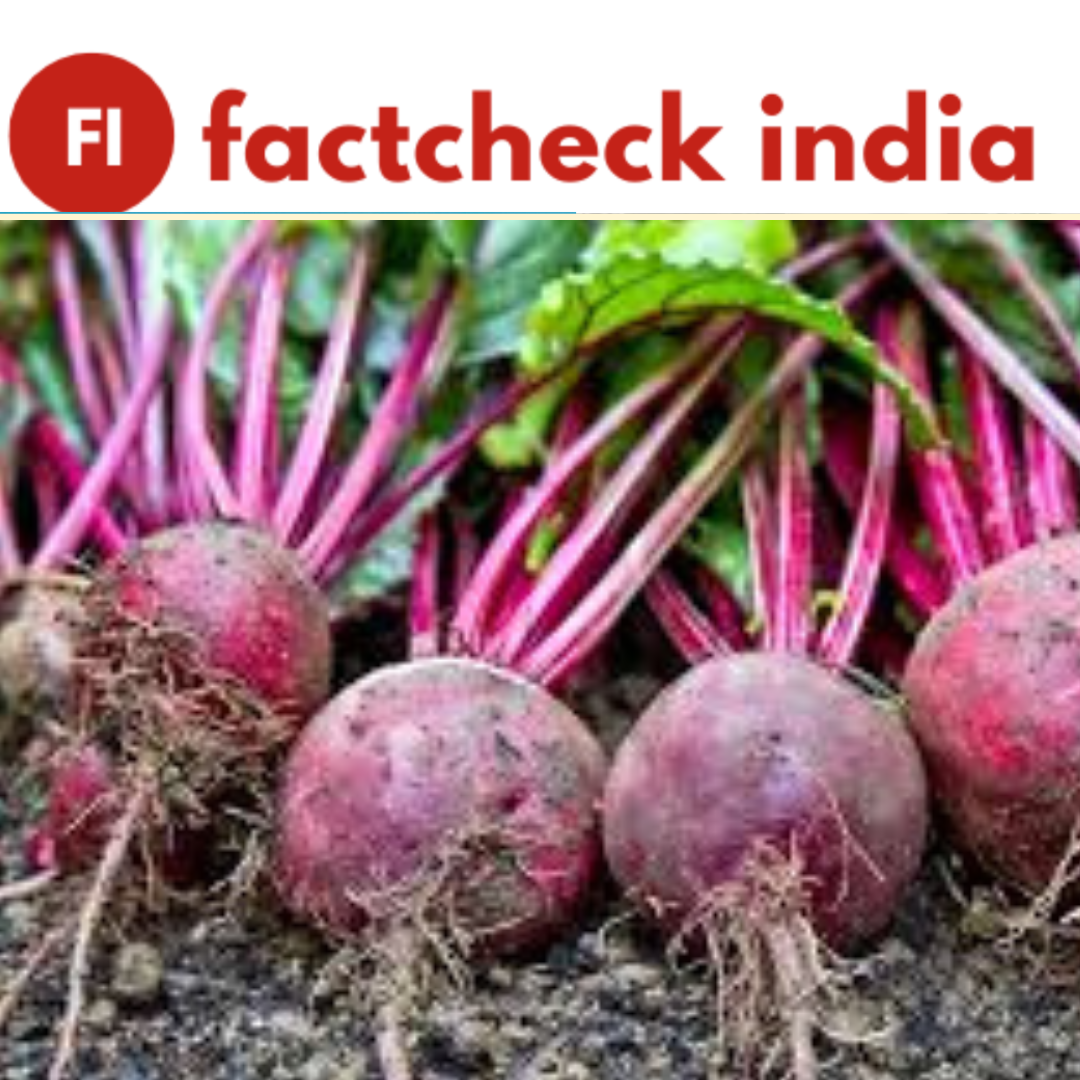
Claim
A viral claim circulating on social media advises people to stop eating beetroot, stating it is “dangerous” and harmful to health.
Fact Check
The viral claim is misleading.
What the Claim Says
The misinformation began after a health influencer named Gupta claimed that people should “stop eating beetroot immediately” because it can be harmful. The claim gained traction as several social media users reshared the statement, citing videos warning against beetroot consumption.
What Factcheck India Says?
Beetroot is globally recognized as a nutrient-dense superfood.
According to the U.S. Department of Agriculture’s Agricultural Research Service (USDA-ARS) database, beetroot contains:
- Proteins: 1.68 g
- Carbohydrates: 9.96 g
- Fiber: 2 g
- Essential phytonutrients, amino acids, minerals, and antioxidants
These components make beetroot beneficial for heart health, blood pressure regulation, and improved stamina. However, scientific research does mention certain health concerns associated with beetroot consumption:
- Excessive nitrate intake:
A review on beetroot juice (BRJ) noted that very high nitrate levels may contribute to the formation of N-nitroso compounds, which are potentially carcinogenic. However, these effects are linked to excessive, not moderate, intake. - Oxalate content:
Beetroot is high in oxalates, which may contribute to kidney stone formation in susceptible individuals. But dieticians emphasize that hydration and overall diet play a bigger role than beetroot alone. - Gut sensitivity:
Beetroot is a high FODMAP food. Those with IBS or IBD may experience bloating or discomfort when consuming it raw. Cooking or boiling beetroot reduces these effects. - Foodborne risks (rare):
A Finnish study in 2010 found that contaminated raw beetroot caused a few short-lived gastrointestinal outbreaks. This risk can be eliminated through proper washing, peeling, and cooking. - Heavy metal accumulation:
Beetroot grown in polluted soils can absorb harmful metals like cadmium or chromium. Buying local, seasonal, and organic produce minimizes this risk.
While beetroot may pose some risks if consumed raw or excessively, nutrition experts and scientific evidence confirm that beetroot is safe and beneficial when eaten in moderation and prepared properly.
Verdict
Beetroot is dangerous and should not be consumed. Beetroot is safe, nutritious, and beneficial when consumed in moderation and cooked properly. Raw or excessive intake may pose mild risks, but there is no scientific basis to avoid it entirely.
thank you for this write up.
Thanks for sharing excellent informations. Your website is so cool. I’m impressed by the details that you have on this web site. It reveals how nicely you perceive this subject. Bookmarked this website page, will come back for more articles. You, my pal, ROCK! I found simply the info I already searched everywhere and simply couldn’t come across. What an ideal site.
certainly like your web-site but you have to check the spelling on several of your posts. Many of them are rife with spelling issues and I find it very troublesome to tell the truth nevertheless I’ll definitely come back again.
Understanding dice game probabilities is key! It’s fascinating how platforms like nustargame app download are now using pattern recognition to help players – interesting to see tech meet tradition! A solid strategy is always best.
Hello very nice web site!! Guy .. Excellent .. Wonderful .. I’ll bookmark your site and take the feeds also…I’m glad to find numerous useful information here in the post, we need work out more techniques in this regard, thank you for sharing.
It’s actually a nice and useful piece of info. I am satisfied that you just shared this helpful info with us. Please stay us informed like this. Thank you for sharing.
Hello there, You have done an excellent job. I will certainly digg it and personally suggest to my friends. I am confident they will be benefited from this website.
fantastic points altogether, you just gained a new reader. What would you suggest in regards to your post that you made a few days ago? Any positive?
Thank you for some other excellent article. Where else may just anyone get that kind of info in such an ideal way of writing? I’ve a presentation subsequent week, and I am on the search for such information.
Thankyou for all your efforts that you have put in this. very interesting info .
I?¦ve been exploring for a bit for any high quality articles or blog posts in this sort of space . Exploring in Yahoo I at last stumbled upon this web site. Reading this info So i am satisfied to express that I have an incredibly good uncanny feeling I discovered just what I needed. I so much certainly will make certain to don?¦t fail to remember this web site and provides it a glance on a relentless basis.
I’ve read several good stuff here. Definitely worth bookmarking for revisiting. I wonder how much effort you put to make such a magnificent informative website.
Thanks for the sensible critique. Me and my neighbor were just preparing to do a little research about this. We got a grab a book from our local library but I think I learned more clear from this post. I am very glad to see such magnificent information being shared freely out there.
Have you ever considered creating an e-book or guest authoring on other blogs? I have a blog centered on the same ideas you discuss and would love to have you share some stories/information. I know my subscribers would appreciate your work. If you are even remotely interested, feel free to shoot me an e mail.
There are some attention-grabbing points in time in this article however I don’t know if I see all of them heart to heart. There’s some validity but I’ll take hold opinion till I look into it further. Good article , thanks and we wish more! Added to FeedBurner as properly
Hey very cool site!! Man .. Excellent .. Amazing .. I will bookmark your web site and take the feeds also…I am happy to find so many useful information here in the post, we need work out more techniques in this regard, thanks for sharing. . . . . .
Hello there, just was alert to your weblog via Google, and located that it is truly informative. I am going to watch out for brussels. I will be grateful for those who proceed this in future. Numerous other people will probably be benefited from your writing. Cheers!
Very interesting information!Perfect just what I was searching for!
Awsome article and straight to the point. I don’t know if this is in fact the best place to ask but do you people have any thoughts on where to employ some professional writers? Thanks in advance 🙂
You are my breathing in, I have few blogs and often run out from to brand : (.
I love the efforts you have put in this, thanks for all the great blog posts.
Some times its a pain in the ass to read what blog owners wrote but this internet site is very user pleasant! .
Thank you for the sensible critique. Me and my neighbor were just preparing to do a little research about this. We got a grab a book from our area library but I think I learned more clear from this post. I am very glad to see such great info being shared freely out there.
I am curious to find out what blog system you happen to be utilizing? I’m having some minor security problems with my latest site and I’d like to find something more secure. Do you have any solutions?
I really enjoy reading on this site, it contains superb blog posts. “One should die proudly when it is no longer possible to live proudly.” by Friedrich Wilhelm Nietzsche.
Excellent site you have here but I was curious if you knew of any discussion boards that cover the same topics talked about in this article? I’d really love to be a part of online community where I can get feed-back from other knowledgeable individuals that share the same interest. If you have any suggestions, please let me know. Bless you!
Thanks, I have just been searching for info approximately this topic for a while and yours is the greatest I’ve discovered till now. But, what about the conclusion? Are you certain concerning the supply?
What i don’t realize is in fact how you are now not actually much more well-appreciated than you may be now. You are very intelligent. You know thus significantly in relation to this matter, produced me in my opinion consider it from so many numerous angles. Its like men and women are not involved except it¦s something to do with Lady gaga! Your own stuffs nice. Always handle it up!
Some really nice and utilitarian info on this internet site, besides I conceive the style holds good features.
Thanks for some other informative web site. Where else may just I am getting that kind of info written in such an ideal approach? I have a venture that I’m simply now working on, and I’ve been on the glance out for such information.
Very nice post. I simply stumbled upon your weblog and wished to say that I’ve truly loved browsing your blog posts. After all I will be subscribing for your feed and I hope you write again soon!
Keep functioning ,impressive job!
Thank you for the good writeup. It in fact was a amusement account it. Look advanced to far added agreeable from you! By the way, how can we communicate?
Your home is valueble for me. Thanks!…
Hello my family member! I want to say that this post is awesome, great written and include approximately all vital infos. I would like to look more posts like this .
You actually make it seem so easy with your presentation but I find this matter to be actually something which I think I would never understand. It seems too complicated and extremely broad for me. I am looking forward for your next post, I’ll try to get the hang of it!
Wow! Thank you! I permanently needed to write on my site something like that. Can I implement a portion of your post to my blog?
Your style is so unique compared to many other people. Thank you for publishing when you have the opportunity,Guess I will just make this bookmarked.2
The subsequent time I read a blog, I hope that it doesnt disappoint me as a lot as this one. I mean, I do know it was my option to learn, but I actually thought youd have one thing attention-grabbing to say. All I hear is a bunch of whining about one thing that you might repair when you werent too busy in search of attention.
Do you mind if I quote a few of your articles as long as I provide credit and sources back to your website? My website is in the exact same area of interest as yours and my visitors would really benefit from some of the information you provide here. Please let me know if this okay with you. Many thanks!
you are actually a good webmaster. The website loading velocity is incredible. It kind of feels that you’re doing any unique trick. Furthermore, The contents are masterwork. you’ve done a magnificent task in this subject!
Well I definitely enjoyed reading it. This article procured by you is very helpful for correct planning.
I got what you intend,saved to favorites, very nice website .
I really like your writing style, wonderful information, appreciate it for putting up :D. “Inquiry is fatal to certainty.” by Will Durant.
Spot on with this write-up, I really assume this web site wants way more consideration. I’ll most likely be once more to learn rather more, thanks for that info.
I do agree with all of the ideas you’ve presented in your post. They’re very convincing and will definitely work. Still, the posts are very short for starters. Could you please extend them a little from next time? Thanks for the post.
Hello! I could have sworn I’ve been to this blog before but after browsing through some of the post I realized it’s new to me. Anyways, I’m definitely happy I found it and I’ll be book-marking and checking back frequently!
Thank you for some other informative site. The place else could I am getting that type of information written in such a perfect means? I have a mission that I’m simply now running on, and I’ve been on the look out for such info.
of course like your web site but you need to check the spelling on quite a few of your posts. Many of them are rife with spelling problems and I find it very bothersome to tell the truth nevertheless I’ll certainly come back again.
This is very interesting, You are a very skilled blogger. I have joined your feed and look forward to seeking more of your wonderful post. Also, I’ve shared your web site in my social networks!
I do agree with all the ideas you have presented in your post. They are really convincing and will certainly work. Still, the posts are very short for novices. Could you please extend them a bit from next time? Thanks for the post.
Of course, what a splendid site and revealing posts, I surely will bookmark your website.Best Regards!
I always was concerned in this topic and stock still am, regards for putting up.
You are my intake, I own few blogs and occasionally run out from to post .
I am not certain the place you are getting your information, however good topic. I needs to spend a while studying more or working out more. Thank you for fantastic info I was searching for this information for my mission.
I truly enjoy examining on this site, it contains superb articles.
Hello there! Would you mind if I share your blog with my myspace group? There’s a lot of folks that I think would really enjoy your content. Please let me know. Cheers
Nice post. I was checking continuously this blog and I am impressed! Very helpful info specially the last part 🙂 I care for such info a lot. I was seeking this particular information for a long time. Thank you and best of luck.
Youre so cool! I dont suppose Ive read anything like this before. So good to find any individual with some unique thoughts on this subject. realy thanks for beginning this up. this web site is one thing that’s needed on the web, someone with a bit of originality. useful job for bringing one thing new to the internet!
There is noticeably a bundle to know about this. I assume you made certain nice points in features also.
Good day! This is my first visit to your blog! We are a group of volunteers and starting a new project in a community in the same niche. Your blog provided us valuable information to work on. You have done a extraordinary job!
Hi there, I discovered your site by means of Google while searching for a similar matter, your web site came up, it seems to be good. I have bookmarked it in my google bookmarks.
Enjoyed looking through this, very good stuff, appreciate it.
After examine a few of the weblog posts in your web site now, and I truly like your means of blogging. I bookmarked it to my bookmark website checklist and will likely be checking back soon. Pls take a look at my web site as properly and let me know what you think.
This web page is mostly a stroll-by for the entire data you wished about this and didn’t know who to ask. Glimpse right here, and also you’ll definitely uncover it.
Very interesting subject, thankyou for putting up. “Experience a comb life gives you after you lose your hair.” by Judith Stern.
Great post. I was checking constantly this blog and I’m impressed! Very helpful information specially the remaining part 🙂 I maintain such information much. I used to be looking for this certain info for a very lengthy time. Thanks and good luck.
I have not checked in here for some time as I thought it was getting boring, but the last few posts are great quality so I guess I¦ll add you back to my everyday bloglist. You deserve it my friend 🙂
My partner and I stumbled over here by a different web address and thought I might as well check things out. I like what I see so now i am following you. Look forward to going over your web page yet again.
Terrific work! That is the kind of information that should be shared around the net. Disgrace on Google for no longer positioning this put up upper! Come on over and discuss with my website . Thanks =)
Thank you for your whole efforts on this site. My daughter loves doing investigations and it’s simple to grasp why. Many of us learn all about the powerful mode you create good things via the web blog and as well foster participation from other ones on this idea so our child is really discovering a great deal. Take pleasure in the remaining portion of the new year. You have been performing a fabulous job.
Great post. I am facing a couple of these problems.
This is very attention-grabbing, You’re an overly professional blogger. I have joined your rss feed and look forward to searching for extra of your great post. Additionally, I’ve shared your site in my social networks!
Incredible! This blog looks just like my old one! It’s on a entirely different subject but it has pretty much the same layout and design. Superb choice of colors!
I found your weblog site on google and verify just a few of your early posts. Proceed to keep up the superb operate. I simply further up your RSS feed to my MSN Information Reader. Seeking forward to studying extra from you afterward!…
Hey! Would you mind if I share your blog with my twitter group? There’s a lot of people that I think would really enjoy your content. Please let me know. Many thanks
Hi, i read your blog from time to time and i own a similar one and i was just wondering if you get a lot of spam remarks? If so how do you reduce it, any plugin or anything you can recommend? I get so much lately it’s driving me crazy so any support is very much appreciated.
Magnificent goods from you, man. I have understand your stuff previous to and you are just extremely wonderful. I actually like what you’ve acquired here, really like what you’re saying and the way in which you say it. You make it enjoyable and you still take care of to keep it smart. I cant wait to read much more from you. This is really a terrific website.
F*ckin¦ awesome issues here. I¦m very happy to see your post. Thank you so much and i am having a look ahead to touch you. Will you please drop me a e-mail?
What i do not understood is in reality how you’re no longer really a lot more neatly-liked than you may be now. You are so intelligent. You already know thus considerably on the subject of this subject, produced me in my view believe it from a lot of varied angles. Its like women and men are not fascinated except it is one thing to accomplish with Woman gaga! Your own stuffs nice. All the time deal with it up!
Having read this I thought it was very informative. I appreciate you taking the time and effort to put this article together. I once again find myself spending way to much time both reading and commenting. But so what, it was still worth it!
I gotta bookmark this web site it seems extremely helpful very helpful
Greetings from Colorado! I’m bored to death at work so I decided to browse your blog on my iphone during lunch break. I really like the information you provide here and can’t wait to take a look when I get home. I’m shocked at how fast your blog loaded on my cell phone .. I’m not even using WIFI, just 3G .. Anyways, fantastic site!
I got what you mean , thanks for putting up.Woh I am thankful to find this website through google.